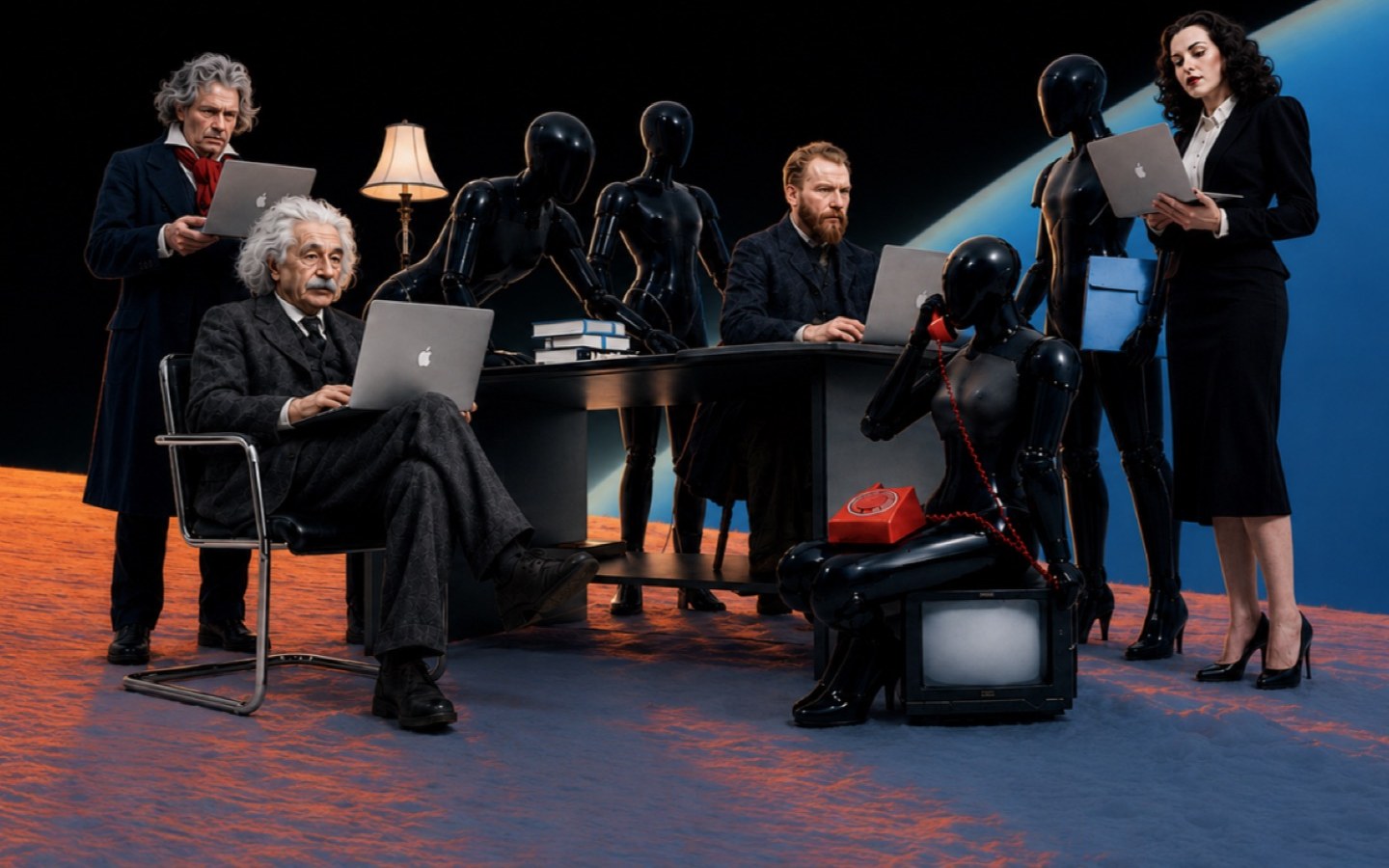


Tutti is a marking in musical notation meaning "all together": every voice plays at once. Today, many people are waiting for a soloist who can replace everyone else. We believe in another possibility: an ensemble of people and Agents. And the ensemble itself is the point.
1. Replacement, or Collaboration
When I was a student, I played in several ensembles. I probably will not go back to that now. But one thing has stayed with me: sometimes, we played for the audience in front of us; more often, the ensemble itself was reason enough. What we enjoyed was the resonance between us. The music, of course, remained. But that was not why we kept gathering again and again.
Collaboration is the same. It can certainly produce useful things. But if we see it only as a means of output, we miss the more important half: many times, we come together to do something simply because we want to be together.
Much of our anxiety around AI comes from forgetting this half. We have quietly accepted a premise: that a person's value equals how much they can produce, as if an ensemble exists only to please the audience. Under that premise, stronger machines naturally mean fewer people.
More than two thousand years ago, Aristotle asked why people become friends, and divided friendship into three kinds: friendship for utility, friendship for pleasure, and the most complete form of friendship. The first two treat the other person as a means, and they dissolve when the benefit or pleasure runs out. The most complete form is to wish good for the other person for their own sake. It only grows through living together and doing things together, through the process of playing together.
There is nothing so characteristic of friends as living together.
Aristotle, Nicomachean Ethics
What a stronger machine can take away is, at most, a particular voice or a particular role. People remain. The reasons we want to be together remain. When an orchestra gains a new player, the task is to rearrange the score and find a new place for everyone, including it.
2. A New Space for Collaboration
What Tutti wants to build is a place where everyone can share the same stage. Here, collaboration can take several forms, all growing from the same root.
- People with people. "I'm going to grab lunch. Can you cover for me?" You send a link to a colleague. They open it and enter your current workspace, then continue from where you left off.
- People with Agents. You bring your Agent. Your colleague brings theirs. Each person works with the Agent they know best, side by side in the same live environment.
- Agents with Agents. They do not need any special protocol. They hand work off to each other through a shared file space: one writes down a result, and another continues from there.
- Within the ecosystem. Someone creates an application, someone distributes it, and someone uses it. Today, these are mostly applications. Over time, there will be more.
These forms of collaboration may look very different, but they all reflect the same idea: people come together to do things because they want to be together.
3. Agents as First-Class Citizens: Designed for Two Kinds of Intelligence
Where Agents should stand follows directly from the definition of this space. We call Agents first-class citizens, meaning they have their own place in this environment and their own best way of working. They are different from people, just as strings are different from woodwinds. What we want to build is a space designed for both kinds of intelligence at once, so their differences can make them better together. What we want are partners that can play in ensemble with people.
This comes down to two things.
The same application should be usable by both people and Agents.
In Tutti, an application naturally has two sides: one interface for people to see, and one interface for Agents to call. Take a small chess application as an example. A person sees the board. An Agent sees the action it can directly call: "make a move." The same object serves two kinds of intelligence in the ways each of them needs.
Context should flow fully between them.
For people, this feels natural in use: everyone shares the same work environment, the same file tree, the same open windows, and the same task already in progress. Whoever you invite in can see the full scene and continue directly from there. For Agents, this means a higher ceiling. We try to connect the context between Agents, and between applications, as much as possible, so that what one Agent knows does not have to be asked again from scratch by another. How well an Agent can perform often depends on how much context it holds. Only when that context is shared fully can collaboration become truly deep.
4. An Open Ecosystem Where Everyone Benefits
There is another, even more important form of collaboration on the internet: the collaboration between developers and users. Developers build good things. Users use them and are willing to pay for them. This should be the most natural thing in the world. But today, there is a barrier in the middle of that path: applications are rarely able to sell on their own. They often have to be sold together with model consumption. The industry has not yet found a proper business model for applications themselves, so applications are tied to model bills and consumed and sold together with the models.
That bundling is the barrier between developers and users. Users can only choose from one bundled package after another, instead of assembling the best combination for their own workflows. Developers also have a harder time acquiring users, because from the beginning they have to compete head-on with the integrated offerings of model companies. What Tutti wants to do is untie that bundle, so application distribution and model consumption can each follow their own path. Applications can then have their own way to live, and users can regain the freedom to choose.
On that foundation, we want to work with developers to build this into a truly open ecosystem. No single model provider should be able to lock everyone in. Choice should return to users and developers. Developers and users should be able to meet and collaborate more freely.
We want to push this ecosystem in a more open and freer direction. We believe this is the kind of AI that can truly enter ordinary people's lives.
Conclusion
To build a collaborative space designed for both people and Agents, driven by an open ecosystem, is to better serve people and a society that still wants to do things together.
For Aristotle, this kind of friendship does not need to be pursued elsewhere. It already exists in the time people spend together, for one another and for the thing itself. So the friendship and bonds that slowly grow from this collaboration are part of the very reason we gather.
Sometimes, we are also willing to offer this ensemble to the audience in front of us. But the ensemble itself is already the point.
That is what the name Tutti means: the ensemble is the point.